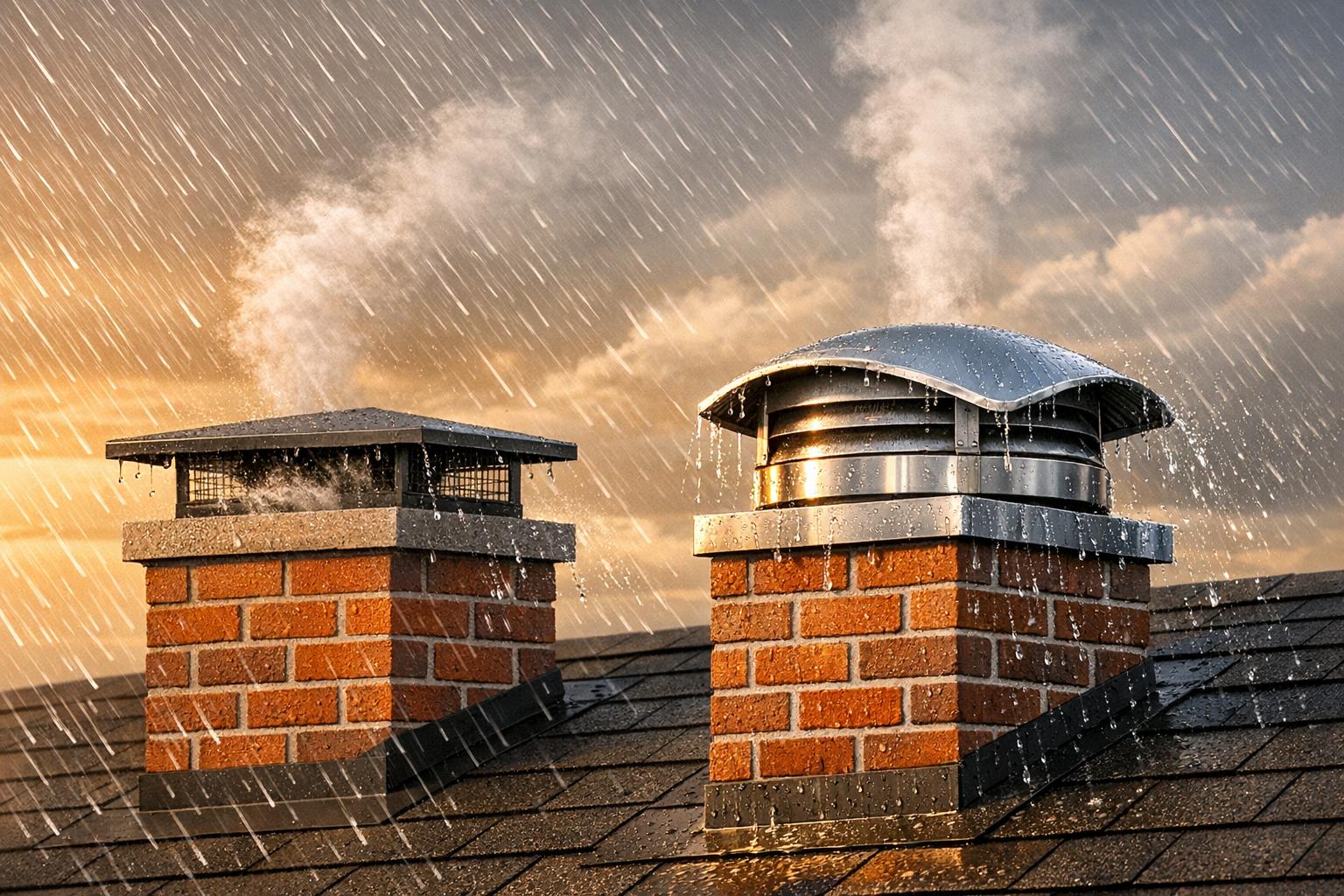
When it comes to protecting your chimney, wind-resistant chimney caps outperform standard caps in severe weather. Both options shield your flue from debris, rain, and animals, but their performance and durability differ significantly, especially in high-wind conditions. Here’s the breakdown:
- Standard chimney caps: Affordable ($75–$450 installed), suitable for calm weather, but prone to failure in winds above 40 MPH. They often require replacement every 5–10 years and struggle with durability against rust and storms.
- Wind-resistant caps: Designed for extreme weather, these caps withstand winds over 110 MPH, prevent downdrafts, and last decades thanks to premium materials like 304-grade stainless steel. They cost more upfront ($500–$950 installed) but reduce long-term risks like water damage and replacements.
Quick Comparison
| Feature | Standard Caps | Wind-Resistant Caps |
|---|---|---|
| Cost (Installed) | $200–$450 | $500–$950 |
| Wind Resistance | Up to 40 MPH | 90–110+ MPH |
| Material Lifespan | 5–10 years (galvanized steel) | 20+ years (stainless steel) |
| Water Damage Risk | High in storms | Minimal |
| Replacement Needs | Frequent | Rare |
For storm-prone areas, wind-resistant caps are a smarter investment, offering better protection and durability. They may cost more upfront, but they prevent costly repairs and ensure safety during high winds.
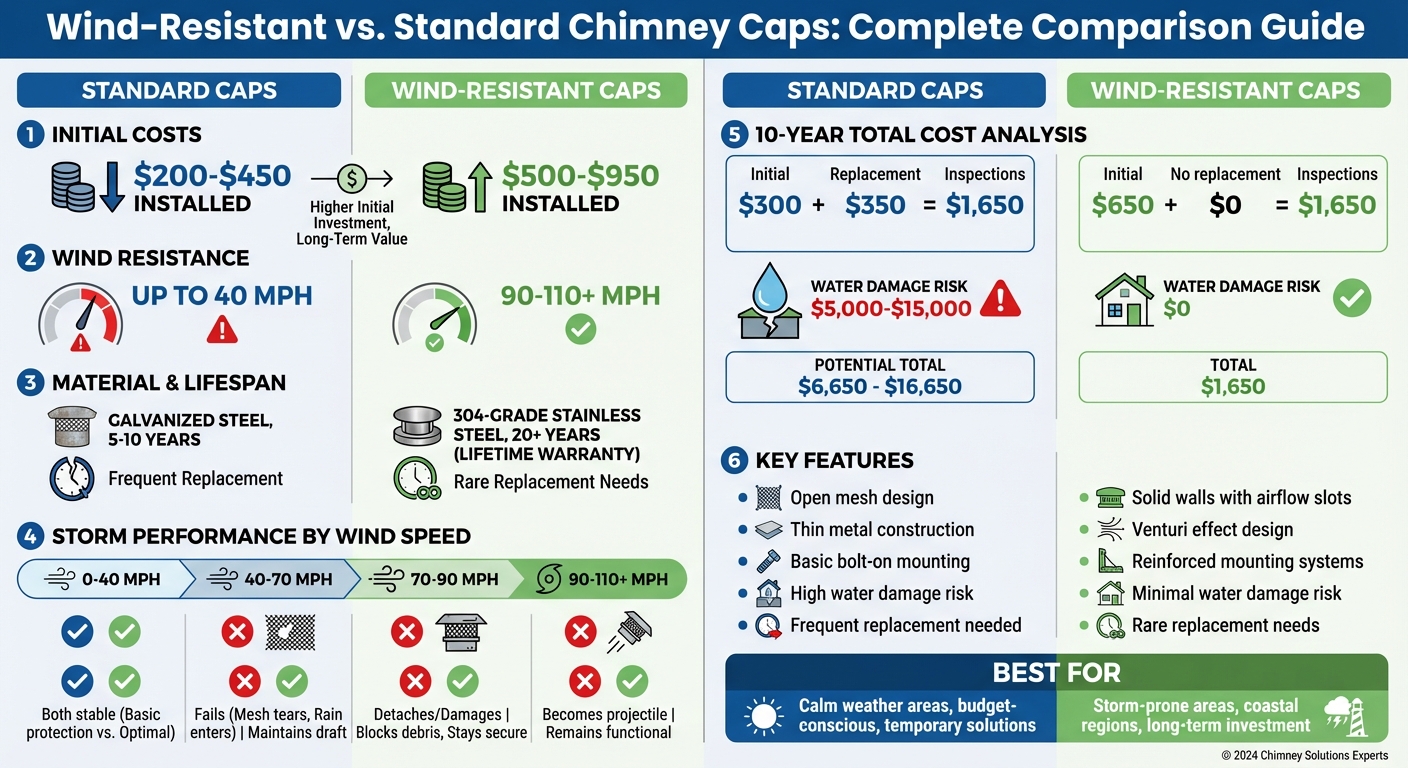
Wind-Resistant vs Standard Chimney Caps: Cost, Performance & Durability Comparison
Standard Chimney Caps: Features and Drawbacks
Materials and Designs
Standard chimney caps come in various materials, each with its own pros and cons. Galvanized steel is an affordable option, lasting about 5 to 10 years, while stainless steel (304 grade) offers durability for over 20 years. Aluminum caps are lightweight and perform well in coastal areas, and copper caps, though premium-priced, can last 50+ years. Black painted steel is another budget-friendly choice but requires frequent upkeep to maintain its condition.
These caps usually feature a straightforward bolt-on or slip-in design with open mesh screens. However, their thin metal construction and basic mounting systems make them vulnerable in harsh weather conditions. Costs for these caps range from $300 to $575, with installation labor adding anywhere from $125 to $1,200, depending on the complexity of the job. While they perform well under ordinary circumstances, their limitations become apparent in extreme weather.
Problems in High Winds
When wind speeds hit 40 MPH or more, the open mesh design can disrupt airflow, pushing smoke, carbon monoxide, and even cold air back into the home – even if the damper is closed.
"Standard thin-metal caps can bend or blow off during storms, leaving your chimney exposed to water damage, critters, and debris. Worse, a loose cap can become a projectile hazard in high winds." – Chimcare
The thin metal used in these caps can vibrate, warp, or detach entirely during storms. Strong winds often force debris into the mesh, clogging it and reducing ventilation, which heightens the risk of toxic fumes building up inside. Wind-driven rain can bypass these caps, seeping into the flue and causing masonry to deteriorate or leading to water damage inside the home. Galvanized steel caps, in particular, are prone to rusting, leaving unsightly stains on the chimney after exposure to severe weather. These vulnerabilities make standard chimney caps less reliable in regions prone to storms and high winds.
Wind-Resistant Chimney Caps: Better Protection
Wind-Resistant Design Features
Wind-resistant chimney caps are built with solid walls and specially designed airflow slots instead of traditional open mesh screens. These slots are engineered to deflect rain and wind while allowing smoke to escape freely. Their aerodynamic shape plays a crucial role in redirecting wind flow. Instead of opposing the wind, the cap uses the Venturi effect – a phenomenon where wind passing over the top creates a vacuum that enhances the chimney’s draft, making it more efficient at pulling smoke out, even during storms.
The mounting system depends on the chimney type. For instance, hurricane caps are secured with reinforced bolt-down mounts, providing extra stability, while air-cooled caps feature a friction-fit design that slides into the inner pipe, avoiding external mounting points that could fail under stress. Additionally, internal baffles are included to reduce the "jet engine" noises caused by high-speed winds. Some advanced models even come with a rotating hood that automatically turns away from strong gusts, ensuring the flue remains protected. These thoughtful design features directly address the challenges posed by high winds.
While standard chimney caps often fail at wind speeds around 40 MPH, hurricane-rated caps are rigorously tested to withstand sustained winds of 110+ MPH. High-wind air-cooled and non-air-cooled caps are typically rated for 90+ MPH, with customer reviews frequently exceeding 4.9 out of 5 stars.
Material Quality and Lifespan
The materials used in wind-resistant chimney caps set them apart from standard options. Most of these caps are made from 304-grade or Austenitic T304 stainless steel, which is highly resistant to saltwater exposure and the corrosive flue gases produced by burning wood or gas. Unlike standard thin mesh screens, these models use heavy-gauge metal that can withstand flexing and fatigue over time.
Premium stainless steel caps are built to endure extreme conditions, including temperatures above 1,500°F and repeated freeze-thaw cycles, without cracking or breaking down. This durability is especially important in coastal areas, where galvanized steel caps – commonly found in standard models – corrode quickly, often lasting only about 5 years if installed within 25 miles of saltwater. In contrast, stainless steel caps frequently come with lifetime warranties, making them a more reliable choice.
When it comes to cost, hurricane chimney caps range from $715 to $1,448, depending on size. High-wind air-cooled caps fall between $450 and $699, while non-air-cooled models are priced from $425 to $699. Standard aluminum caps cost between $90 and $200, and galvanized steel options range from $50 to $325. While the upfront cost of wind-resistant caps may seem higher, they are a smarter long-term investment. Standard caps often require replacement every 5–10 years, whereas stainless steel models offer durability and value that far outweigh their initial price.
Performance Comparison: Standard vs. Wind-Resistant Caps
Storm Performance
When severe weather strikes, the difference between standard and wind-resistant chimney caps becomes crystal clear. Standard caps begin to fail at wind speeds around 40 MPH. Their open mesh design creates turbulence, which can tear the material away from its mounting brackets. In contrast, wind-resistant caps take advantage of the Venturi effect, improving draft performance even as winds pick up.
As conditions worsen, the gap in performance widens. Standard caps, often made from aluminum or galvanized steel, are prone to bending, breaking, or even becoming dangerous projectiles in high winds. Their mesh design also allows horizontal rain to enter the flue and can cause downdrafts, creating safety hazards. On the other hand, wind-resistant caps feature solid outer walls and carefully designed airflow slots. These features block debris and rain while maintaining proper ventilation. Hurricane-rated models can even function seamlessly in sustained winds of 110+ MPH.
| Wind Speed | Standard Cap Performance | Wind-Resistant Cap Performance |
|---|---|---|
| 0-40 MPH | Stable under normal conditions; offers basic protection | Performs optimally; prevents downdrafts entirely |
| 40-70 MPH | Mesh may vibrate or tear; rain can enter the flue | Aerodynamic design redirects wind and maintains draft |
| 70-90 MPH | High risk of detachment; prone to damage | Solid walls block debris; remains securely in place |
| 90-110+ MPH | Likely to fail or become airborne | Hurricane-rated models stay intact and functional |
While storm performance is critical, durability plays an equally important role in long-term reliability.
Durability Over Time
The longevity of a chimney cap largely depends on the material it’s made from. Caps constructed from galvanized steel tend to corrode quickly, often needing replacement after just 5 years. Aluminum caps last longer – about 10 to 15 years – but are prone to bending under stress. Both materials require regular inspections and eventual replacement.
Wind-resistant caps, however, are built with durability in mind. Many are made from 304-grade stainless steel, which is designed to last. This material resists corrosion from acidic flue gases, withstands extreme temperatures of over 1,500°F, and endures repeated freeze-thaw cycles without cracking. Thanks to their resilience, these caps often come with lifetime warranties, reflecting the manufacturers’ confidence in their performance. Copper caps are another high-end option, offering a lifespan of over 30 years, though they require occasional cleaning to maintain their appearance. Additionally, wind-resistant models feature reinforced mounting systems – such as bolt-down or friction-fit designs – that prevent the loosening and metal fatigue commonly seen with standard brackets over time.
sbb-itb-5427fa3
Cost Comparison
Purchase and Installation Costs
Wind-resistant chimney caps stand out for their durability and performance, but this comes at a higher initial cost compared to standard caps. Standard caps, typically made from galvanized steel or aluminum, are more budget-friendly upfront. These cost between $75 and $150 for the cap itself, with professional installation adding another $125 to $275. Altogether, the total cost for a standard cap ranges from $200 to $450.
On the other hand, wind-resistant caps require a larger initial investment. Models designed for high-wind areas are priced between $425 and $699, while hurricane-rated options range from $715 to $1,448. Installation costs for these caps fall between $200 and $350, bringing the total price to $500 to $950 or more. These higher prices reflect the use of premium materials like 304-grade stainless steel and reinforced mounting systems, specifically engineered to withstand extreme weather conditions.
"A $300 cap prevents thousands in damage and shows responsible maintenance." – Builds and Buys Research Team
Long-Term Costs
When it comes to longevity, standard galvanized steel caps often fall short. They typically last 5 to 10 years before rust and wear necessitate replacement. Over a decade, a homeowner might spend $300 on the initial installation, $350 on a replacement around year six or seven, and $1,000 on annual inspections (at $100 per year), totaling $1,650.
In contrast, wind-resistant stainless steel caps are built to last. With no need for replacement during the same 10-year period, the total cost equals $650 for the initial installation plus $1,000 for inspections, also amounting to $1,650. While the upfront costs for wind-resistant caps are higher, their durability offsets replacement expenses, leveling the long-term financial playing field.
The real distinction lies in their ability to withstand storms. Standard caps are prone to failure during severe weather, which can lead to costly water damage repairs ranging from $5,000 to $15,000. Wind-resistant caps, however, are designed to virtually eliminate this risk, offering peace of mind in addition to financial savings.
| Expense Type | Standard Cap (10 Years) | Wind-Resistant Cap (10 Years) |
|---|---|---|
| Initial Purchase & Install | $300 | $650 |
| Replacement Cost | $350 (Year 6–8) | $0 |
| Annual Inspections | $1,000 | $1,000 |
| Total Cost | $1,650 | $1,650 |
| Water Damage Risk | $5,000–$15,000 | $0 |
Choosing the Right Chimney Cap
Key Factors to Consider
Climate plays a crucial role. If you live in coastal areas or regions with high winds (zones II, III, IV), selecting a wind-rated chimney cap is essential. Standard caps can fail when winds hit 40 MPH, while hurricane-rated caps are built to withstand speeds over 110 MPH. In areas prone to storms, these durable caps not only prevent water damage but also stop smoke from backing into your home.
Material quality determines durability. Chimney cap materials greatly affect their lifespan. For instance, galvanized steel typically lasts about five years, while 304-grade stainless steel can endure for decades. Stainless steel is designed to handle extreme temperatures – up to 1,500°F – and often comes with a lifetime warranty. This means you can avoid frequent replacements and enjoy consistent performance for years.
Professional installation ensures optimal performance. While a DIY approach might work for low-pitch roofs, hiring a professional is highly recommended for steep roofs or when installing heavy-duty hurricane-rated caps. Professionals ensure precise measurements and secure mounting, which are critical for creating the positive pressure needed to reduce downdrafts. They also enhance the Venturi effect, improving draft efficiency during storms.
By considering these factors and seeking expert help, you can select the best chimney cap for your home and enjoy long-lasting benefits.
How 1 Chimney Services Can Assist

With these priorities in mind, 1 Chimney Services offers expert chimney care to homeowners in the greater Seattle-Tacoma area. Their services cover inspections, cleaning, flue repairs, and restoration, all tailored to the Pacific Northwest’s unique weather conditions, including high moisture and strong winds. Their team is well-equipped to help you choose the perfect chimney cap for your needs.
Whether you’re looking for a professional evaluation of your current cap, an upgrade to a wind-resistant model, or routine maintenance to keep your chimney system in top shape, 1 Chimney Services has you covered. They provide detailed inspection reports and practical solutions, using advanced tools and partnering with trusted brands. Serving over 60 cities in the region, they deliver reliable and efficient service.
Visit https://1chimneyservices.com to schedule an inspection and find the ideal chimney cap for your home.
Best Chimney Caps for Windy Conditions
FAQs
What are the long-term savings of using wind-resistant chimney caps?
Wind-resistant chimney caps can save you money over time by tackling two common issues: downdrafts and debris buildup. Downdrafts can mess with your heating efficiency, while debris can cause blockages or even damage your chimney. By addressing these problems, these caps help cut down on repair and maintenance expenses and keep your chimney system in good shape for the long haul.
Another bonus? These caps act as a barrier against moisture and debris, two culprits behind water damage and structural wear. This added protection helps ensure your chimney stays safe, functional, and reliable for years to come.
What makes wind-resistant chimney caps effective at stopping downdrafts?
Wind-resistant chimney caps are specially crafted to tackle downdrafts by steering airflow away from your chimney’s opening. With their wind-directional design, they adapt to shifting wind conditions, preventing gusts from forcing smoke or harmful fumes back into your home. By keeping the draft steady, these caps not only enhance the efficiency of your chimney but also safeguard the quality of the air inside your home.
Why is stainless steel a top choice for wind-resistant chimney caps?
Stainless steel is a go-to material for wind-resistant chimney caps, thanks to its durability and ability to resist rust and corrosion. It can withstand tough weather conditions like heavy rain and strong winds, offering reliable protection for your chimney over the long haul.
What’s more, stainless steel is low-maintenance and built to last, making it a smart, budget-friendly option for homeowners aiming to improve their chimney’s safety and performance.